
JOSEPH FIENNES “SHAKESPEARE UNCOVERED” INTERVIEW
JOSEPH FIENNES “SHAKESPEARE UNCOVERED” INTERVIEW
Joseph Fiennes interview about his role hosting the Romeo and Juliet segment of PBS’ Shakespeare Uncovered, airing February 13th.
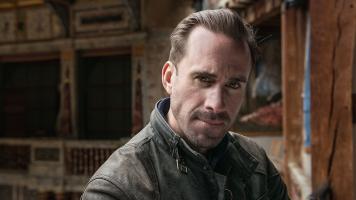
Joseph Fiennes
In 2012, England’s BBC4 and America’s PBS, via member station WNET New York Public Media, joined together to bring forth SHAKESPEARE UNCOVERED, a series of documentaries about Shakespeare’s plays, which aired on PBS in 2013. Each segment, hosted by someone famed for their connection to the Bard’s work, was full of insights into the source and inspiration of the plays and interviews with notable interpreters of the material.
Two years later, a second season of SHAKESPEARE UNCOVERED is airing on PBS. The first two segments, with Hugh Bonneville on A MIDSUMMER NIGHT’S DREAM and Christopher Plummer talking about KING LEAR, ran Friday, January 30. Kim Cattrall hosting ANTONY AND CLEOPATRA and David Harewood on OTHELLO will be telecast Friday, February 6 and Morgan Freeman discussing THE TAMING OF THE SHREW and Joseph Fiennes on ROMEO AND JULIET will run Friday, February 13.
[easyazon_block add_to_cart=”default” align=”left” asin=”B00PHD6EY6″ cloaking=”default” layout=”top” localization=”default” locale=”US” nofollow=”default” new_window=”default” tag=”buzmag-20″]SHAKESPEARE UNCOVERED[/easyazon_block]Fiennes, a Briton, is doubly associated with Romeo, not only having played the role on stage, but also having portrayed William Shakespeare himself playing Romeo in the 1998 Oscar winner SHAKESPEARE IN LOVE. Fiennes is also familiar to audiences for a great deal of other stage, film and television work, including playing Martin Luther in LUTHER, FBI Special Agent Mark Benford in the American science-fiction series FLASHFORWARD, the wizard Merlin in Starz’s CAMELOT and an ambitious priest in AMERICAN HORROR STORY: ASYLUM.
Fiennes is at the Pasadena Langham Hotel to discuss his work on SHAKESPEARE UNCOVERED with the Television Critics Association. He shares a Q&A panel with WNET’s vice-president of programming Stephen Segaller, SHAKESPEARE UNCOVERED producer Richard Denton and fellow performers Cattrall and Harewood.
Fiennes and Harewood actually worked together previously in the 2004 film adaptation of THE MERCHANT OF VENICE, starring Al Pacino. Fiennes played Bassiano and Harewood essayed the Prince of Morocco.
When Fiennes sits down for a one-on-one discussion of SHAKESPEARE UNCOVERED, the MERCHANT/Harewood connection is one of the first things that comes up.
“We go back a bit,” Fiennes says of Harewood. “We bonded with our experience on that wonderful film, and I adore David, and it was great to know that he was joining the panel and is part of SHAKESPEARE UNCOVERED.”
Asked whether he wanted to examine ROMEO AND JULIET in his UNCOVERED segment or whether he would have preferred a different Shakespearean work, Fiennes first literally points a finger. “The culprit is sitting over there.” Producer Denton laughs from his perch on the couch. He’s observing out of what he says is curiosity on exactly what interviewers want to know about UNCOVERED.
As Denton indicates he’d rather have Fiennes do the talking here, the actor explains his thoughts on why he was asked to specifically uncover ROMEO. “I understand why, given SHAKEPEARE IN LOVE tackles ROMEO AND JULIET as the main theme, it seems appropriate. At my grand old age [Fiennes was born in 1970], does it speak to me like some of the other plays? No, but I still have a place for ROMEO AND JULIET in my heart. I think it’s the most exquisitely written piece, but there are more interesting [plays] as I get older. MEASURE FOR MEASURE or something like that would be an interesting one to tackle. There’s a complex period of Shakespeare’s life, that middle section, is something that I’m kind of more attracted to, but having said that, I think [ROMEO AND JULIET is] a play which is really important, because it’s about that first love, as I mentioned in the panel. And it’s important because I think if you’re going to invite an audience who don’t necessarily know Shakespeare, this is a great play to start with, and a young audience, too, because it speaks to them, I think.”
Part of Fiennes’ UNCOVERED journey is speaking with various actors, including Orlando Bloom and Condola Rashad, and talking to Stephen Sondheim, who used Shakespeare’s work as the basis for his musical WEST SIDE STORY.
Also included in the documentary is Fiennes bringing Shakespeare to youths in a London reformatory school. Fiennes relates, “A big part of the discussion with Richard was, yes, it’s really important that we are uncovering Shakespeare, and essentially uncovering the straightforward narrative. Who are the protagonists, what is the story, what are the acts, where does it go, how does it finish? And then there’s the whole really interesting background of the academics – we know part of Shakespeare’s genius is that he’s stealing, he was the biggest plagiarist ever,” Fiennes observes with a laugh.
“But for me, the big driving force of participating was uncovering Shakespeare through language. And these plays, rather like James Joyce and ULYSSES – I don’t pretend to know that book well, but I have read it out loud to myself and that’s when I engage. And it’s the same with Shakespeare. I think it is about intoning the language and thereby uncovering who this man is and what that language means to us through sound. It’s just as organic as sound and articulation. And if you can connect with the sound of the shape and the noise and the frame and the beat, its music, then you can make contact with it and you have ownership of it.”
Which, Fiennes continues, is where the students come in. “So that took me to the schools, it took me to working with young offenders [and] a wonderful guy called Bruce Wall, he’s amazing, he’s been working twenty years in this way. What I learned from this was actually the Shakespeare that was spoken in the schools, and most importantly, by the ex-offenders through Bruce’s work. I somehow engaged more with their interpretation or their connection with the language than I did some of the actors [interviewed for the documentary] who were seasoned actors playing on the stage. So it just backed up my theory that [Shakespeare is] for everyone. It’s all about just the keys. The keys [are], it’s the iambic, it’s the meter, it’s like jazz, it’s like twelve bars. You get that and then you’re in, you can riff. And it belongs to everybody and anyone, and that’s how I feel we should uncover Shakespeare.”
Fiennes says he’s not sure whose idea it was for him to go into the schools, but he remembers not wanting to go to Italy, where ROMEO AND JULIET is set. “I think it was generally a collaborative effort. I think it might have stemmed from me, but Richard and I collaborated through emails on this. I did say, ‘Listen, I don’t want to go to Verona. It’s beautiful, but it’s museum stuff to me. I want to go to a South London school and talk to children about what that language means to them.’ It’s about first love, first love for a young couple. For me, uncovering Shakespeare is talking, connecting with them, rather than a balcony in Verona or me talking about when I played Romeo or when I played Will playing Romeo, what that was like. That’s valid and important, but for me to be invested in the project, I didn’t want to talk about myself and how it was great to play Will, or how it was great to play Shakespeare playing Romeo, which is important, but for me to be attached to it, it’s language and it’s young people and it’s an audience who haven’t necessarily dealt with Shakespeare. Because that’s why we’re doing this.”
Teaching was something of a new experience for Fiennes, although, he says, “I’ve done some workshops that I kind of borrowed from Cicely Berry, who was integral to the Royal Shakespeare Company [Berry is the company’s voice director] and to many actors there. I loved working with her, and she is brilliant in finding your ownership to the language, and I really borrowed from Cecily’s workshops, and I’ve worked with children and young students in schools as they prepare a bit of Shakespeare and just ripping it up and having fun, essentially running around the room, shouting it out, finding ownership.”
Asked whether there’s any corollary between acting and teaching, Fiennes replies, “For me it’s about joy. If you’re a teacher that brings joy, or if you’re a performer that brings joy, then yes. Is it [philosopher Michel de] Montaigne who said, ‘Seriousness in art is of no avail; joy is the only guide’? I think if you’re going to teach or impart anything, you’ve got to do it with a bit of joy, and going back to the Bard, it’s joyous. We talk about all these compartmentalized histories and tragedies and comedies, but you look at the play, and actually, each play is a history, comedy, tragedy. He didn’t compartmentalize, he would go from the joy in order to then go to the more profound elements.”
Did Fiennes have any say in who else he might be interviewing about the play? “I leave that to the professionals, because I think it’s really important that Richard and WNET and PBS, they understand their audience. I’m working in a far tinier zone and they know the bigger picture, so obviously they handpick who they want to talk to in order to take us through the basics of the background and the narrative. Because hopefully, this is for an audience who know nothing about Shakespeare; that’s what I want. And even if they do know Shakespeare, they’ll all learn something new. So I think it’s a balance between the solid foundations of what Richard and the directors have brought in terms of who’s going to take us through and uncover the wider picture, and then you have the personal element, which is whether that actor has played the part or what that actor feels about why are they uncovering, and what does uncovering mean. Because my sense of uncovering is different from anyone else’s, because everyone is wanting to have their own interpretation of Shakespeare and wanting to have their own interpretation of explaining Shakespeare. It’s just deeply personal and it all comes back to the theatre itself.”
Asked whether he learned from any of the interviews he conducted, Fiennes replies, “Well, everyone that was involved brings their own fresh perspective that you can only learn from. I particularly liked speaking with Bonnie Greer. She was wonderful and great, because obviously, [Fiennes and Denton have] a male perspective, Will playing Romeo on the film – but to have that [female perspective], to really talk about Juliet, who is just this profound force of nature, and so brilliant and articulate and mature and connected and vibrant and sexually alert and way ahead of anyone else in the play, and it was great hearing Bonnie Greer talk about Juliet.”
His personal reactions to Shakespeare as audience and performer, Fiennes says, are in a constant state of evolution. “It’s always changing, because I’m changing. I’m not who I was even a minute ago probably, molecularly, biologically, spiritually, mentally, and I think it’s the same with generations. We are not the same, but we are dealing with the same conditions, and I think, for sure as I get older, there are plays that are more appropriate. I was at the RSC for a couple of seasons, did a few plays and I would love to go back and revisit, or not necessarily revisit, but tackle characters that might speak to me now.”
Did Joseph Fiennes ever experience a light bulb moment in his relationship to Shakespeare, when he realized at a specific moment how he felt about a particular aspect of the work? “Actually, I played a tiny part in AS YOU LIKE IT, I played Sylvius. I don’t know if it’s a light bulb moment, but [I realized] how generous all Shakespeare’s characters are, whether you’re a lead or if you just come on for a couple of lines. He’s so generous. He loves his characters and his actors. But I think the rapport between your audience is for me just the most addictive and exhilarating. If you’re on point and it’s working, this well-oiled machine just takes you to the stars and back. Just being on that ride in any capacity is a real connective moment for me.”
As a performer, how does Fiennes approach his hosting duties on SHAKESPEARE UNCOVERED? He likens it to how he believed actors worked with Shakespeare back in the day. “I’m sure he would have collaborated with the actors and producers, and Richard and our director and myself, we collaborated on this. There’s a piece to the camera at the very end which is just all me, that’s no one else giving me any lines, that just comes out of how I feel. And that’s why I felt it was really important that, if I do this, you’ve got to have a reason for doing it and not just explaining the narrative, because then it can be scripted. But if you want to go beyond that, you’ve got to know why you’re there and all the reasons are really about language and ownership to others who don’t know it. So that in the end brings me to talk fluently about it.”
Many actors who perform Shakespeare also direct the plays, but Fiennes says that’s not for him. “I do not have any desire, and I have not directed Shakespeare. I’m barely struggling as an actor understanding it, let alone someone who can orchestrate other actors to do so, so I think I’m a long way off.”
There are some Shakespearean roles Fiennes is keen to tackle. Besides Angelo in MEASURE FOR MEASURE, he says, “We’re talking about OTHELLO [in SHAKESPEARE UNCOVERED], and Iago is someone I’m particularly interested in. I think anyone who wants to play Hamlet should be of that age; that’s long gone. You can’t have a forty-year-old Hamlet. There have been a few, but I think if he’s a student, he’s that young, he’s of an age around his mid-twenties, it kind of unlocks the play. I think RICHARD II would be something I’d love to look at. There’s a whole host.”
Changing the subject for a moment, FLASHFORWARD was allowed to wrap up at the end of its first and only season, but it was abrupt. Fiennes acknowledges he was disappointed. “I was deeply dissatisfied. I think it should have run. It was very sad. I think we let a bunch of fans down in not continuing, but that’s politics beyond my control and knowledge.”
Joseph Fiennes has two feature films, STRANGERLAND and CLAVIUS, due for release later this year. Meanwhile, is there anything else he’d like to say about SHAKESPEARE UNCOVERED right now?
“I think we covered it, but I think if you love language, if you want to be entertained, if you love history, if you love theatre, if you love life in general,” Fiennes laughs at his “if” list, “you’ve got to see SHAKESPEARE UNCOVERED.”
By Abbie Bernstein

Hit SUBMIT and we'll send it straight to you FREE


