Send to Kindle
EXCLUSIVE INTERVIEW: “THE BLETCHLEY CIRCLE”
Jake Lushington, Rachael Stirling, Hattie Morahan
By Abbie Bernstein
Productions 2013
Bletchley Park is a real place in England. During World War II, it was where the British government headquartered the Intelligence workers tasked with deciphering the codes used by the enemy. An unusually high percentage (for the era) of those working at Bletchley Park were women.
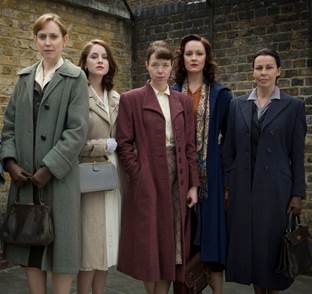
The first season of THE BLETCHLEY CIRCLE, which aired last year in the U.S., takes place after WWII has ended. Former Bletchley Park worker Susan, played by Anna Maxwell Martin, is now married and the mother of two, but when she sees patterns she recognizes from her war days in the handiwork of a serial killer, she is determined to put her dormant skills to use. Although it takes some persuasion, Susan rounds up some of her old Bletchley colleagues – former boss Jean, played by Julie Graham, young memory whiz Lucy, played by Sophie Rundle, and convention-defying Millie, played by Rachael Stirling – to track down the murderer.
Season Two of THE BLETCHLEY CIRCLE begins Sunday, April 13, on PBS. The new season consists of two separate two-part stories. The first one finds Millie trying to find out the truth about condemned murderer Alice, played by Hattie Morahan, who stubbornly won’t speak up in her own defense.
Stirling and Morahan, along with BLETCHLEY CIRCLE executive producer Jake Lushington, are all in attendance at PBS’ section of the Television Critics Association press tour. The trio sit down in a small meeting room to talk about their show, where it’s been and where it may go.
Lushington began his television career as a writer on the venerable British soap opera EASTENDERS and has since moved on to produce a number of series in England. He explains how THE BLETCHLEY CIRCLE was born. “It’s an original idea by Guy Burt, who has written all the episodes so far. He is a kind of geek by nature who loves radio devices and computing devices and the history of computing and its codes. I’d worked with him as a writer I think about five years before, and I had a general meeting with him. He said, ‘Well, I’ve got this idea …’ He’d actually taken it to a couple of other people, and they’d gone, ‘Oh, I don’t know …’
“I really liked the idea and I commissioned him to write a treatment about it and then I let the channel [ITV] know about it, and they said, ‘Oh, this sounds quite good, and we’d like to see a script,’ and it literally just went like that. I think what had happened with the story before was that people wanted to make it softer than it was, and he said, ‘I’m not really interested in doing a kind of just a tea party show. I want to do a show where things happen and these women actually have to face difficulty.’”
Stirling started performing on the big screen in the rock ‘n’ roll comedy STILL CRAZY and has credits including SALMON FISHING IN THE YEMEN, CENTURION, SNOW WHITE AND THE HUNTSMAN and the DOCTOR WHO episode “The Crimson Horror.” The actress says she more or less insisted on getting involved with THE BLETCHLEY CIRCLE.
“I was doing a play at the Donmar, and all the other girls in the dressing room were reading the scripts. I read somebody else’s script and thought, ‘Why the f*** am I not being seen for this?’ I got in a terrible temper and rang up my agent and bullied him into getting me a meeting,” she laughs, “and then marched into the audition and said to Jake, ‘I’m Millie, give me the job.’”
Lushington joins Stirling in laughter. “And I wish I could say she’s making that up. She’s not making that up. ‘I’m obviously the part’ is what I think you said,” he reminds Stirling, who laughs again. “And she obviously was. So I gave her the part.”
“I love playing parts where they’re miles away from you,” Stirling elaborates, “but then occasionally someone comes along and you go, ‘I know this lady,’ and that was the case with [the character of Millie].”
Morahan was born in London into a show business family; her father is director Christopher Morahan and her mother is actress Anna Carteret. She began working in film and television at the age of eighteen. Major credits include Elinor Dashwood in the BBC version of SENSE AND SENSIBILITY and the features THE GOLDEN COMPASS and THE BANK JOB.
Coming into BLETCHLEY CIRCLE for its second season, Morahan says she had a chance to see the first season before joining the company. “I really loved it. It’s such a fantastic cast and I love the premise and I just thought it’s so beautifully made, so I was really thrilled when I got to read for the second season. And yeah, I just came in and met, and Jake had seen me in a couple of shows …”
“I have to confess,” Lushington interjects, “I was quite biased. I had seen Hattie in two plays over the course of the year since we’d done the first season, and we were talking about a new character and I pretty much had made up my mind. But I actually then sat back and let everybody else discover that I was right.”
“I’d worked with the [BLETCHLEY] director as well, Jamie Payne,” Morahan points out.
“And Jamie was a big fan of Hattie’s as well,” Lushington relates.
“It’s a lovely part,” Morahan continues, “and it’s what Rachael was saying. Sometimes you get parts and you think, ‘Oh, this is going to be a stretch,’ and sometimes you think, ‘Oh, I really get this person,’ and it felt like she fitted like a glove, so it was a real honor, lovely.”
Morahan has a somewhat personal connection to the history of Bletchley Park. “A friend of mine’s mother wrote to me and said they discovered her sister had been a Wren – she worked for the Navy during the war, which is what my character did, and none of them discovered it until the 1970s, when the Official Secrets Act was lifted. But our director for the second block, Sarah [Harding], her mother was at Bletchley Park, which was extraordinary, actually.”
“For her, it was almost a voyage of discovery,” Lushington adds. “There are pictures that she found of her mother with some of her girls, which get shown behind the scenes I think you see when the PBS show goes out, and you can see a group of women with her mother in it, an old reel of Bletchley Circle of those friends from Bletchley.”
According to Stirling, director Harding’s memories of her youthful days were colored by secrecy. “She said that she remembered from her childhood certain female friends [of her mother] turning up that she didn’t know the history of, but she knew there was a history. It feels reminiscent of this, these kind of very close bonds that were forged, but also, she felt that her mother and maybe some of her mother’s friends never quite found the purpose or the outlet after the war that they would have done during the war, and that’s what’s so powerful, I think, about this premise, is that there are these women who find routes through which to use their intelligence and wit. So I find it very sad to think about all the people who might have, decades afterwards, felt very frustrated and without a purpose.”
What sort of research went into working on BLETCHLEY CIRCLE?
Stirling speaks first. “I loved learning about the microcosm of Bletchley Park. It was its own little world and it was inhabited by these wonderful, eccentric, intelligent people, but it sort of didn’t have to abide by regular rules of society. They were expected to do something extraordinary, and at the same time, they were allowed to behave in extraordinary ways. There’s the story of [code breaker] Alan Turing – he used to have his cup of tea by the lake, and then at the end of his cup of tea, he just lobbed the cup and the saucer in the lake in this rather extraordinary fashion.
“I thought he attached his cup to his radio,” Morahan adds, “because he was so paranoid.”
Stirling laughs. “I’m told he chucked it in the lake every day.”
Lushington feigns horror. “You think that tea was the most interesting thing about Alan Turing?”
“It was just about the hothouse collective of all these minds together,” Stirling says, returning to the original question, “and what that might have been like, and I suppose that then casts a light on how grey these lives in the 1950s must have seemed, deeply depressing after this kind of freedom that they had within the confines of Bletchley Park. So trying to get into the mindset of the kinds of experiences they would have had there, rather modern experiences, even by this decade’s [standards]. I hear there were stories of – I think a lot of the Wrens worked for the Navy – their bed and board was at the abbey nearby and there were all these stories of topless bathing on the beach,” she laughs. “There’s a fantastic book, SECRETS OF BLETCHLEY PARK, which is basically compiled from hundreds of interviews just about the minutiae of daily life and the AmDram [amateur drama] societies that sprung up and the romances and the actual matter of day-to-day work – how they got there, where they lived, what they could and couldn’t tell people, what the people in the village thought – and it’s just fascinating. And how long the hours were that they worked. They worked twenty-four-hour shifts and slept in snatches. So that’s fascinating to think about. Anna and I in the first series had a scene where we’re coming back from work and we’re staying in our little boarding room together and sharing – we’re in twin beds in this tiny little room. Actually, that reminds me a bit of boarding school, so it felt a bit familiar to me. But yes, [research helped to inform] just how hard they worked and how hard they played.”
When the Circle begins, Millie is clearly its most worldly member, and her forthright, rule-breaking qualities rub off a little on her friends. Does Stirling think the other women are having an effect on her character?
“I think, as in life, friendships change you a bit,” Stirling replies. “Certainly she’s the most independent of them, but I think she’s also at the same time probably the loneliest in some ways. She’s a sort of pioneer of all this independence and go-getting and everything, but at the end of the day, she goes back to her flat on her own and they don’t see each other for weeks at a time. So I think that motherly attitude that Jean has is rather important to Millie. She herself is quite maternal towards Sophie, so yes. The dynamics within the relationship are forever changing and you see that in the drama. What I love about it is, you see us grow, you see our friendships grow and you see them develop. And so yes, we are changed. It’s not like something where it’s an individual episode where everybody seems unaffected by what went on the week before. We are changed by each other.”
One of Stirling’s favorite scenes in the series, she says, relates to the connection between the characters. “I had to do this in the audition – I loved the first scene with Anna, where Susan comes to Millie’s flat to ask for help, and then we go to the café where I work, and it’s this brilliantly written observation of two girls who have this rich history and friendship, but something has gone wrong between them, and you see all these simmering tensions and resentments, but also a real love and affection and familiarity with one another. But as with all good writing, they didn’t feel the need to over-explain what it was that had happened to these characters. So there was so much going on between the lines, and Anna is absolutely brilliant, and I love playing with her, with all the actresses. We make each other raise our game a bit, so you feel like you’re doing your best work, because you’re working with fantastic actresses and I really felt that with Anna. It was a whole past suggested but not mentioned, and I was proud of that.”
Creatures that live in the extreme depths of the ocean cannot survive being brought to the surface – the lack of pressure causes them to explode. Is that an apt analogy for the women of BLETCHLEY CIRCLE?
“It’s not so much an explosion as kind of like they’re just suddenly painted in shades of grey,” Stirling opines. “Having had that kind of heightened experience, some of the women, Anna’s character are suddenly rammed back into domesticity and expected to get on with pretty mundane lives.”
“Although I don’t want the analogy to be too specific,” Lushington says, “it’s more like animals in the wild and animals in a zoo. I think you feel like these people have run free in a pack and done amazing things, and then somebody says, ‘Okay, can you live in this little small thing, with a moat and an enclosure, and it’s exactly the same as when you ran through Africa.’ And that’s the feeling, I think, is of people who’ve got enormous potential and enormous capacity who then go, ‘This is your world, now live in this little place.’ And I think that’s what the Fifties was like. It’s a very small world from a very big world.”
Morahan adds, “Having known that you were involved in something that mattered, you’re one cog in an enormous machine, but you might make a breakthrough that could affect this little chain of reaction, and that sudden sense of lack of place in the world …”
Stirling completes the thought. “Of freedom. You were expected to conform after having been allowed to flourish in this odd little enclave.”
Is that sense of purpose something the actresses experience when they’re working? “We all get on really well and we’re very rambunctious “ Stirling responds with a laugh, “and we’re quite loud and lairy, so we’re modern-day women right up to the minute that they say, ‘Action,’ and then suddenly we’re rammed back into what it was like, back into these rather restricted characters, so there is a kind of analogy there. It is similar in some ways.”
“I think it’s interesting that they are a very loud and boisterous crowd, our leading actresses,” Lushington says, “but I think they’re almost more loud and boisterous because they have to be so buttoned-up in the show. So in a way, if we were doing a crazy show where they had to be crazy all the time, I think they’d be more quiet.”
Stirling recalls laughing a lot on set
Lushington says he learned some valuable lessons about storytelling from his early days writing on EASTENDERS. “It was the Nineties. So I sort of bounded free, actually. The independent company that I work for, World, I did my first new shows with them a long time ago, around 2000, and that did feel like breaking free very much. Although I would say [EASTENDERS was] an apprenticeship. It’s a place where you tell so many stories over twenty weeks – too many, probably, but that’s what the audience wants and that’s what the show is – but it means when you come back to those stories again and you want to tell a story better, you know the simplest way of telling it, and then you can investigate it in a different way, so it’s good training.”
On BLETCHLEY CIRCLE, the actors have input into their characters. “We’re quite mouthy,” Stirling observes. “Jake and Guy, obviously, come up with the brilliant stories and the characters and that sort of stuff, and then we stick our oar in the minute we get a script. We go, ‘My character wouldn’t say that, grr, grr, grr,’ and we get involved, but only because we care and want to make it as good as possible, and also because we’re clever women as well.”
Morahan adds, “And what’s really lovely is, it feels like, on set, everyone’s on the same page, that the end result is we all want to make it as good as we can, so there’s real attentiveness within the cast, I think. There’s a Scooby-Doo alert,” she laughs, “so if the lines come out that any character could have said any line, and we get to the answer really quickly in a really sort of pat way, [it is changed]. It’s just trying to keep the complexity and the credibility of it, and making sure that whatever is happening from the crime-solving point of view is filtered through the characters.”
“And I would say,” Lushington elaborates, “the broad storyline I think everybody normally rather loves, but actually, a broad storyline is only as good as the detail within it and the characterization within it and the way those stories are worked through. We go through several drafts with Guy. An incredibly important part is having the input of the [people who play the] characters and their positions and how they feel. ‘Okay, this is a great character scene, but also, it does this,’ or ‘This is a scene where I feel we’re just giving the plot,’ and we don’t want it to be like that, and so we work very hard and if that comes [from the actors], we’re quite responsive to that, and we go, ‘Okay, I’ve got to go and look at this and who is this about, and wouldn’t this person think this?’ So there’s a great dialogue about how the stories get told.
“Also,” Stirling says, “it’s quite good, because we’re objective. It’s always good to have fresh eyes to a script, and things go through so many versions that sometimes there are kind of hang-overs from a previous storyline, and so we take Jake to task – ‘What the hell is this about?’” she laughs.
However, Lushington notes that sometimes the cast members object to elements because they don’t yet have the full picture. “They do sometimes go, ‘This is absolutely rubbish and wrong,’ and we go, ‘No, no, this, this and this.’ So it works both ways round, I would say.”
THE BLETCHLEY CIRCLE has a very small writers’ room, compared to most American series, Lushington says. “It’s easy. It’s England. The writers’ room is the writer and me.”
In crafting the stories, do Burt and Lushington have to figure out how to apply Bletchley Park deductive techniques to the clues? “Yeah, we do,” Lushington answers, “but we’re not slavish to it. A lot of shows go, ‘This clue just means this, this and this.’ The thing about Bletchley Park, about these women, is they’re used to analyzing lots of data. And what they do is, they make sense of a lot of information, rather than deducing everything from one piece. So I suppose that’s our rule – we can have a couple of bits of one piece of information goes to another piece of information, but if we’re really employing what these women did, what actually modern policing has become about, data analysis and profiling, these women were great at being able to see a pattern or see a solution in a huge amount of stuff. So that’s something we do keep. Any time there are too many what I would call ‘one-stop’ jumps of idea or information, it can be coupled. It isn’t like Sherlock Holmes – he’s all about, ‘That means that and that and that.’ It’s wonderful to watch – it’s not what [the BLETCHLEY characters’] skill is. Their skill is not deducing through little connections. Their thing is looking at a huge amount of material and going, ‘This is what’s really going on within that material.’”
Given that they’re both playing geniuses of a sort, do Stirling and/or Morahan understand the way their characters’ minds work? It turns out that the actresses relate best when their onscreen alter egos are doing something the women can do in real life. “Translation is not a difficult thing to do for me,” Stirling relates. “I love the roots of words and that kind of thing. In Season Two, there’s a certain amount of Slovakian. I did Russian at university, and so you see Millie translating Slovakian using her knowledge of Russian and the etymological roots of the words. I pored over that script. I wanted it to make sense to me, so I got out the Slovakian dictionary – thank God for Google Translate,” Stirling laughs. “And we worked with somebody who spoke Maltese, so the language skills are very much on the show.”
Stirling studied Russian “because I wanted to read Chekhov in the original. Because I couldn’t understand – whenever you’d go and see a Chekhov play, there are all these English actors breast-beating, turning it into raging melodrama, whereas actually when you read THE SEAGULL in the original, he says, ‘THE SEAGULL – a comedy.’ And we seem hell-bent on turning it into Greek drama, whereas for him, it’s typical Russian mentality, that in the most dire circumstances, you will see babushkas on the street, selling everything that they own but howling with laughter. And so I wanted to read it.”
For Morahan, Alice’s technical skills are a way into the character. “Alice’s strengths seem to be, she’s good with machines. She operated machines at Bletchley Park, so she’s got a good systematic brain, which I kind of feel I vaguely do, probably not as much as her, but when it gets to the actual operating of the Enigma [decoding machine], they would have had a bit more training than we did], and we were sort of doing one little moment of it.
“There is something exhilarating about getting to play people whose minds work very, very quickly and trying to honor that and make that credible and turn those corners. It’s a bit like doing Shakespeare or something, where you’re like, ‘I’m just going to have to trust that this character thinks like this.’ And you just go for it rather than giving yourself a thinking space. And I also love playing moments of failure and awkwardness,” she adds with a laugh.
Lushington notes, “The thing that is interesting in conversation with the actresses about it is, you never have a conversation which is, ‘Well, I’m not sure I would have come to that conclusion.’ None of us would – none of us understand. So there is that whole thing where we’re all on the journey trying to understand how these brilliant women were, because none of us are obviously brilliant – none of us have that in our brains, and that’s one of the fun things about it, is to imagine what it might be like to have those minds. It means that we’re all making leaps as a show, rather than anybody saying, ‘Well, my character wouldn’t think that.’ You do have that emotionally still, those conversations, but you’re always trying to attain to this weird [state of genius].”
There are experts on hand to make sure the production team gets it right, Lushington notes. “We have advisors from Bletchley Park. Especially when we get to the code-breaking, it’s quite hard to understand.”
“It’s very, very complex,” Stirling agrees. “But the principle is, you have a version in your head of what it means - I think you have to understand what you’re saying in order to play somebody who’s thinking [in those terms].”
“What we don’t do in the show,” Lushington emphasizes, “although we do obviously have to simplify some things, is have one of them go into that kind of STAR TREK, ‘Ah, the blah-blah-blah of the blah-blah-blah, and therefore, we do this.’ We do actually work it out and then give it to people and try and talk it through and try and make it make sense and have a version of it, also because we owe the people whose life histories we’re borrowing from. We’re not science fiction, we’re science fact.”
When we meet Alice, she’s in prison and under sentence of death, but Morahan says she didn’t put a lot of time into researching women’s correctional facilities. “Not a massive amount. I mean, one reads a little bit, but I can’t imagine that women’s prisons would be very different from women’s prisons now. A prison is a prison. You just play the situation that’s written in the script. And sets do an awful lot. It was a very big place to film in,”
“It was a really good set,” Lushington observes. “I think the thing about the fact that women were hung at that point and being prepared to die, I think that’s actually a harder thing …” He stops himself and turns to Morahan. “I don’t mean to be speaking for you …”
“No, no, you’re spot-on,” Morahan assures him.
“That’s kind of a weird thing to play,” Lushington concludes.
“And Alice is so focused,” Morahan agrees. “She’s got one goal in her sights and I think she thinks she can cope if she just focuses on the purpose of why she’s there and what she’s doing it for. But if one lets one’s mind wander, then that’s where it’s terrifying, and it is terrifying. She’s a dark horse, really, when we first meet her and is keeping all her cards to her chest and seems to be perversely not acting in her own interests. There are secrets in her past which are informing her current decisions. She’s a very interesting mixture. She’s sort of a very good compartmentalizer,” she laughs. “She’s very determined, as you say, and has a very rational, logical brain, but also emotionally, I think things run very, very deep and she’s quite self-protective because of events in her past and quite guarded, so I think it takes a character like Millie to bring her out of her shell a little bit.”
Asked about favorite scenes, Morahan answers easily, “I liked pushing Julie over a wall.”
“We all liked that,” Lushington agrees with a laugh.
Stirling elaborates. “We were howling with laughter, and actually, it was a comedy interlude, when the drama stakes were too high, and we were trying to escape out of Bletchley Park, and we were trying to work out how we get Jean over this wall, and I clamber up the wall and we turn around to look at Jean and say to one another, ‘How are we going to do this?’ and Millie says, ‘Well, I’ll pull, you push,’ and we couldn’t quite cope,” she laughs. “We went a little bit CARRY ON BLETCHLEY. It’ll make the DVD extras.”
In the end, the scene was cut. “The wall was not necessary,” Lushington says. We see them break in, we don’t need to see them break out. Paul Abbott, who wrote SHAMELESS, always says, ‘You don’t have to see the milk poured to know that the cup of tea has been made.’”
As for what we can expect from the latter half of Season Two, Lushington says, “Millie has a very big part in it. A lot of our stories start at Bletchley Park. This one actually finishes there and comes back to code-breaking from a story that doesn’t seem like it’s about that at all. It’s sort of about the morality of the Fifties. We had rationing for ten years and [the story is set] just before it finishes, so it goes into the morality of the black market and people trafficking, the displaced people of Europe, and what people were doing with them – something that’s still happening to this day.”
“And there’s a cracking female villain,” Stirling adds.
“And there’s a very good female villain, yes,” Lushington concurs. “A lot of people are going, ‘Why are all the bad guys men?’ And we didn’t really respond to them, but we definitely found somebody who wasn’t so nice who was a woman.”
If there is a third season, Lushington says, “We’d like to do something about what these women can do now. Wouldn’t they be picked up by MI-6, wouldn’t they be part of the Secret Service? And I think looking at whether some of them could or not, whether they might rejoin – I think if you’re telling a story about the third series, it’s about whether ultimately their destiny is back doing what they used to do in some ways.”
What would the interviewees most like people to know about Series Two of BLETCHLEY CIRCLE?
Lushington says, “I’d like people to know that it’s fabulous, but also that it will take you on different kinds of rides, that it’s a great thriller, but it’s not just a murder mystery, it’s not just a procedural. It’s a character-led thriller story that really manages to do [explore] some things that were challenging in [society] at the time, but also tell a damn good tale about women doing really incredible things.”
Stirling laughs. “What he said!”
Interviewed by Abbie Bernstein
Abbie Bernstein is an entertainment journalist, fiction author and filmmaker. 
Don't Miss Any Buzzy Mag Exclusive Interviews!
Sign Up For Our FREE Email Updates