Halting State
Author: Charles Stross
Publisher: Ace; Reprint edition (June 24, 2008)
ISBN-10: 0441016073
ISBN-13: 978-0441016075
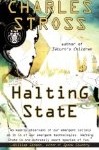 Halting State falls pretty firmly into the Cyberpunk genre, though the near future depicted there does not have the typical dark and gritty atmosphere, but rather a slick and polished one. A future where Scotland has become the silicone valley of the European Union. Aside from this discrepancy, its pretty standard cyberpunk fare.
First of all, the near future setting is an extremely plausible one, based on current trends in existing technology. Take the current state of broadband and phenomena like internet dating, email addiction, IMing, people being mistaken for muttering madmen because of blue toothed ear buds, palm pilots and blackberries. Virtually everyone has a mobile phone and a computer. When the internet goes down or the phones can’t get a signal, business grinds to a halt and personal lives are adrift in limbo. It is no stretch of the imagination at all to envision a time a few decades from now when everything and everyone is wired 24/7, traveling the information super highway on a mobile device that is not only phone and camera but personal computer. People staring at screens projected on the inside of their sunglasses, waving their hands in the air to manipulate a cursor only they can see and tap a virtual keyboard responding to implants in their fingers. It’s a world where no one is ever lost, either geographically or in a conversation, because Google is available at the blink of an eye. It’s a world where cars can drive themselves and the walls have not only ears but eyes as well, and you better indulge your right to remain silent because every cop is a walking surveillance camera logging evidence.
In this only slightly futuristic world, it seems that a company running the financials for several popular MMORPGs (massive multiplayer online games) has just been the victim of a daring daylight bank robbery by a bunch of orcs and their pet dragon.
That’s right, they robbed a virtual bank inside an MMORPG . Why this actually affects anything in the real world and is important enough to warrant calling everybody from the cops to the Scottish equivalent of the CIA is the subject of several conversations laced with techno-jargon and economic theory that, unfortunately, I understood about as well as I understand Egyptian hieroglyphics. These explanations probably made perfect sense to the employees of Blizzard Entertainment and got the code monkeys who built and administrate Second Life extremely excited, but they just didn’t do much for yours truly.
I don’t know many gamer geek code monkeys there are out there, but they appear to be the exclusive audience for which this book was written. It was definitely not written for we who blissfully use technology without understanding how anything actually works and in ages past, bemoaned the math involved in pen-and-paper role playing. It’s not as if the story couldn’t have been told without this very audience specific technical mumbo-jumbo. The Matrix didn’t feel the need to explain to me exactly how the computers worked. They took a second to show me some crap scrolling on a screen and said “Yep, that’s the code for the Matrix”, and that was it. No more IT gobbeldeygook after that. Like I said. I think this book was written for guys who built their own computers out of cereal boxes in the 6th grade and would just curl up in a ball and fall into a coma if the power went out.
Among the books many nods to gamer geekdom are frequent references to Dungeons and Dragons. The “Back in the good old days of the first edition Advanced Dungeons and Dragons, when the assassin was it’s own character class…” kind of reference. Then there is the use of role playing jargon, such as Noob and Pwn3d. But the most blatant and annoying of these is the horrifying use of second person perspective in a book with not one but THREE main protagonists, none of which is YOU. You do NOT, I repeat NOT choose your own adventure here.
All that, PLUS the pace of the story for the first two thirds of the book had all the characteristics of a fatigued sloth. This is not a long book but it took me over a week to read it. This may not seem like anything, but to put it in perspective I’ll read a book that size that I really like in a couple of sittings. However, I can only take very small doses of lethargic plot punctuated by techno babble and the accompanying attempts of the techno-babblers to explain what they just said to the less tech-savvy characters.
The techno-babbling protagonist, Jack, is mildly interesting, at least towards the end of the book when things start to come to a head. The other two are Sue, a cop who doesn’t do much besides make sarcastic comments in her head and Elaine, Jacks’ love interest. She’s the forensic accountant on the case. Yes, that’s right - a forensic accountant. It’s exactly as cool and exiting as it sounds.
That the book is the way it is should come as no surprise. Charles Stross lives in Scotland, and in his early years wrote articles for the legendary role playing magazine White Dwarf (some of his creations even wound up in the infamous Fiend Folio - for that alone, I’d buy the guy a beer any day). In addition to his writing career which ranges from Dungeons and Dragons articles to novels in the cyberpunk and science fiction genres, he’s worn a wide range of hats including that of software developer.
I don’t want to say the book was bad, because it really wasn’t from a technical stand point. It’s well written. It’s the story that just didn’t do it for me - that, and the whole technical slant on it. However, if you’re a gamer and a hacker, or even just a wannabe hacker, you might enjoy it a lot more than I did. I can’t imagine there are many books more up your alley than this one.
By Matt Walker